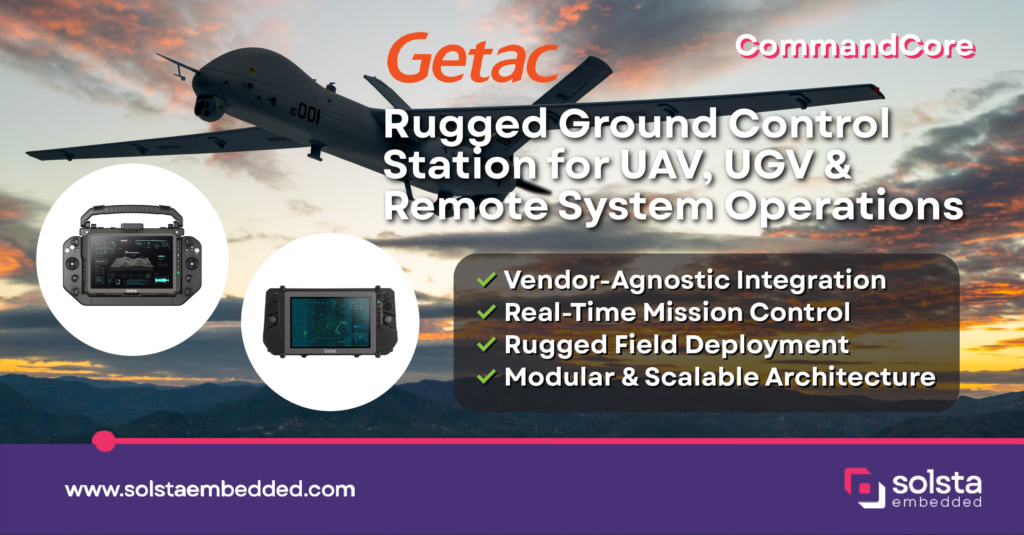
CommandCore is a new remote drone control station aimed at professionals in the defence, public safety and utilities industries. Customers can choose from an extensive range of Getac devices, accessories and payloads to suit their unique needs and use cases. CommandCore is designed to integrate smoothly within diverse drone ecosystems and support interoperability with third-party technologies.
Getac Technology Corporation (Getac) is a leading provider of rugged computing and mobile video solutions and a manufacturer with advanced in-house capabilities.
CommandCore lets customers combine Getac’s proven rugged hardware with industry-specific accessories, payloads and software based on their individual needs and use case. The result is a comprehensive UAV/USV/UGV control solution that is fully adaptable and can be tailored to suit a wide range of challenging environments and operational scenarios, such as those found in the defence, public safety and utilities industries.
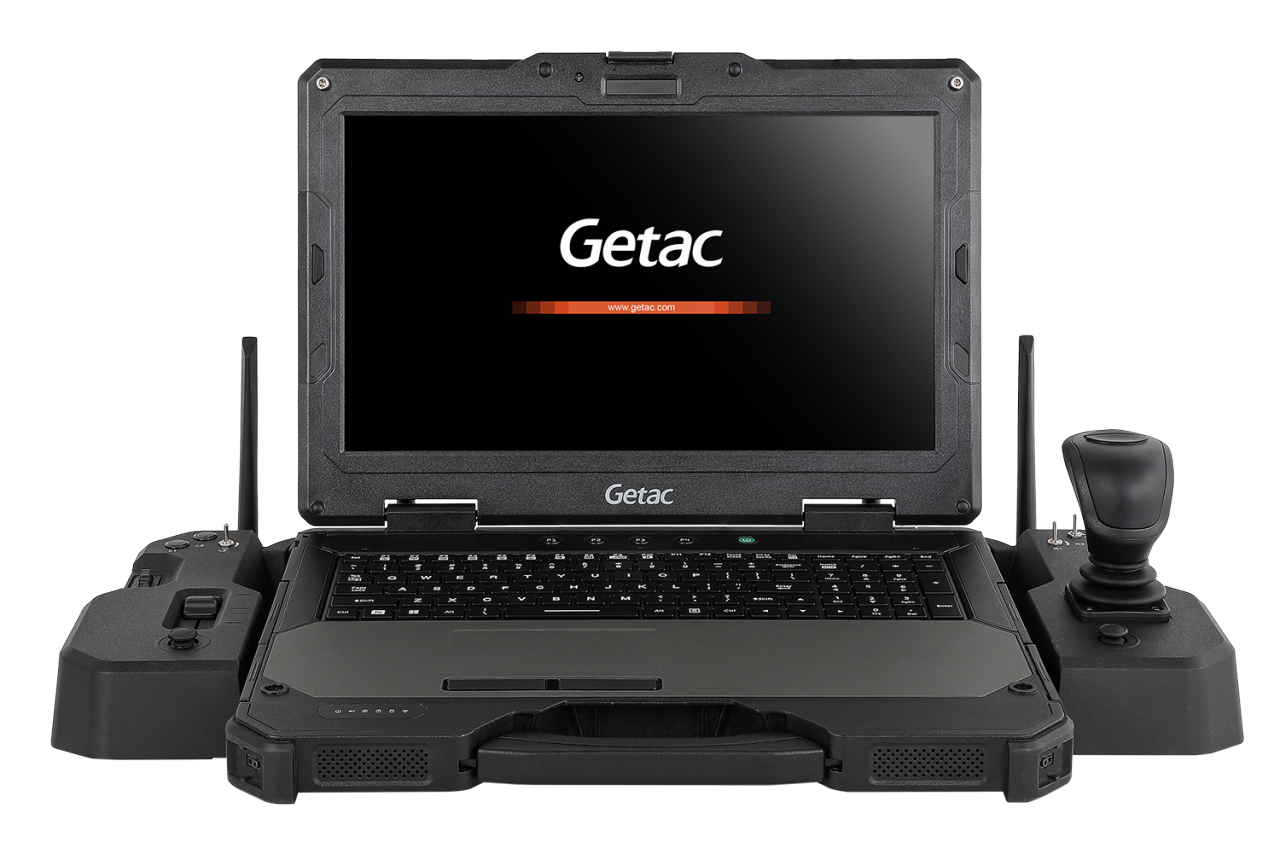
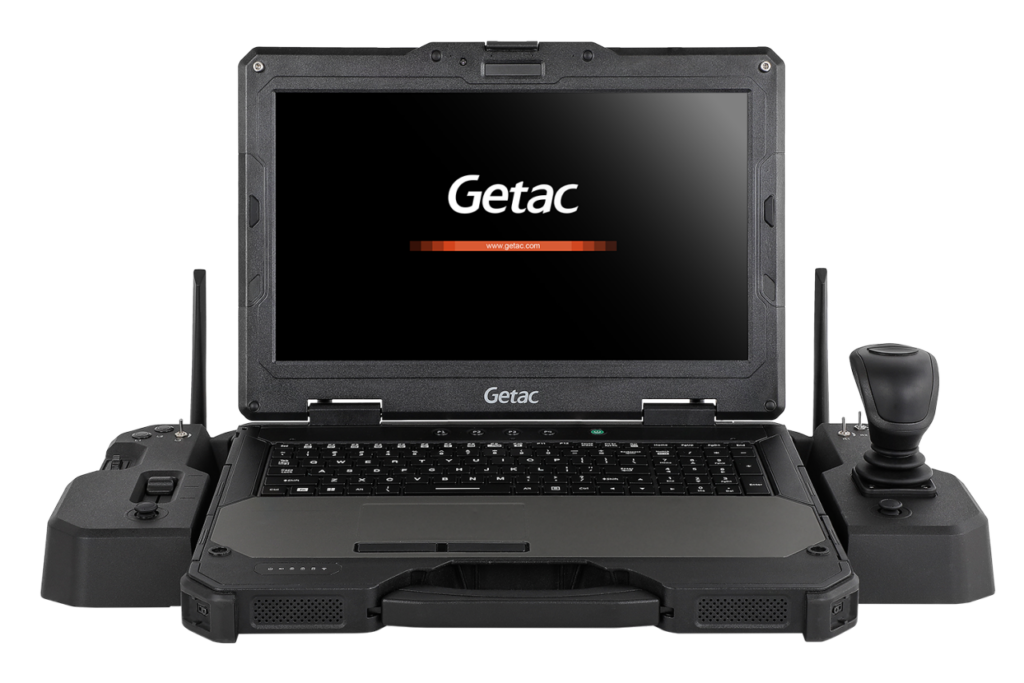
At the heart of CommandCore is Getac’s Ground Control Station (GCS), which serves as a centralised, mission-ready hub, designed for real-time data processing, seamless drone control in extreme conditions, and overall management of operational parameters. Customers can choose between a number of different Getac devices depending on their GCS needs, including the ZX80 fully rugged Android tablet, UX10 fully rugged Windows tablet, S510 rugged Windows laptop, B360 fully rugged Windows laptop, and X600 fully rugged Windows workstation.
The form factor of the GCS can also be customised for maximum flexibility. Options include a fully integrated design with built-in drone controls and an accessory-type design that lets users separate the Getac device from externally housed drone controls as needed. Additional form factors include an office dock design, and a comprehensive suitcase design with dual display for use as part of mobile command and control activity.
Rugged reliability meets modular architecture
CommandCore has been engineered from the ground up to withstand harsh, unpredictable, and mission-critical operational environments without compromising on performance. Its proven rugged design ensures reliability in the field, while its scalable and configurable system architecture enables seamless customisation, expansion, and adaptation to evolving operational requirements across a range of industries.
For the defence sector, this modularity is underpinned by Getac’s sophisticated engineering depth and system-level design skills. Rather than offering a fixed configuration, Getac reserves maximum flexibility within the CommandCore architecture to customise the solution for specific mission requirements and unique end-user needs. By leveraging Getac’s advanced in-house manufacturing capabilities, Getac offers tailored configurations to support the complex demands of multi-domain operations.
An open ecosystem supporting smooth integration
CommandCore integrates smoothly with diverse drone ecosystems, supporting interoperability with third-party technologies and long-term collaborative system evolution. Getac’s GCS is available in both Android and Windows options, while the stable, high performance computing platform supports real-time, mission-critical operations in demanding situations and environments.
Setting a new benchmark in remote drone control solutions
CommandCore facilitates seamless drone operations in extreme terrain and/or high-pressure situations, like those regularly encountered in the defence, public safety and utilities industries:
Defence: Supports intelligence, surveillance and reconnaissance (ISR) activity from both mobile and semi-fixed command posts, informing mission planning and execution strategies in real-time across land, sea and air. Given its robust capabilities, CommandCore is uniquely positioned to support the complex requirements of Army aviation and integrated air defense systems, providing operators with the reliable control and data visualization necessary for critical tactical operations. Public safety: Drone reconnaissance now plays an integral role in disaster response operations ranging from fires and floods to emergency search and rescue. CommandCore lets first responders gather critical information quickly and efficiently, either from a nearby mobile command vehicle or directly from the scene using a handheld GCS. Utilities: Enables utilities professionals to remotely inspect large-scale infrastructure and assets such as powerlines, substations, pipelines, and railways using waypoint guidance from a centralised operations centre. Beyond large-scale monitoring, CommandCore delivers the reliable remote control needed to rapidly assess hard-to-reach rural areas, minimising the need for crews to physically navigate high-voltage or dangerous terrain.
We are delighted to announce that Leander Rabe has been appointed to the position of General Manager, Solsta USA.
Since joining Solsta in November 2025, Leander has demonstrated strong leadership capability and has made a positive impact on both the organisation and the wider team. In his previous role as Vice President of Distribution and Sales, Leander achieved significant progress in strengthening customer relationships and driving growth opportunities across the USA distribution business.
As General Manager, Leander will focus on aligning all aspects of the USA distribution team and systems to better position the business for future growth. We wish Leander every success in this well deserved new role!
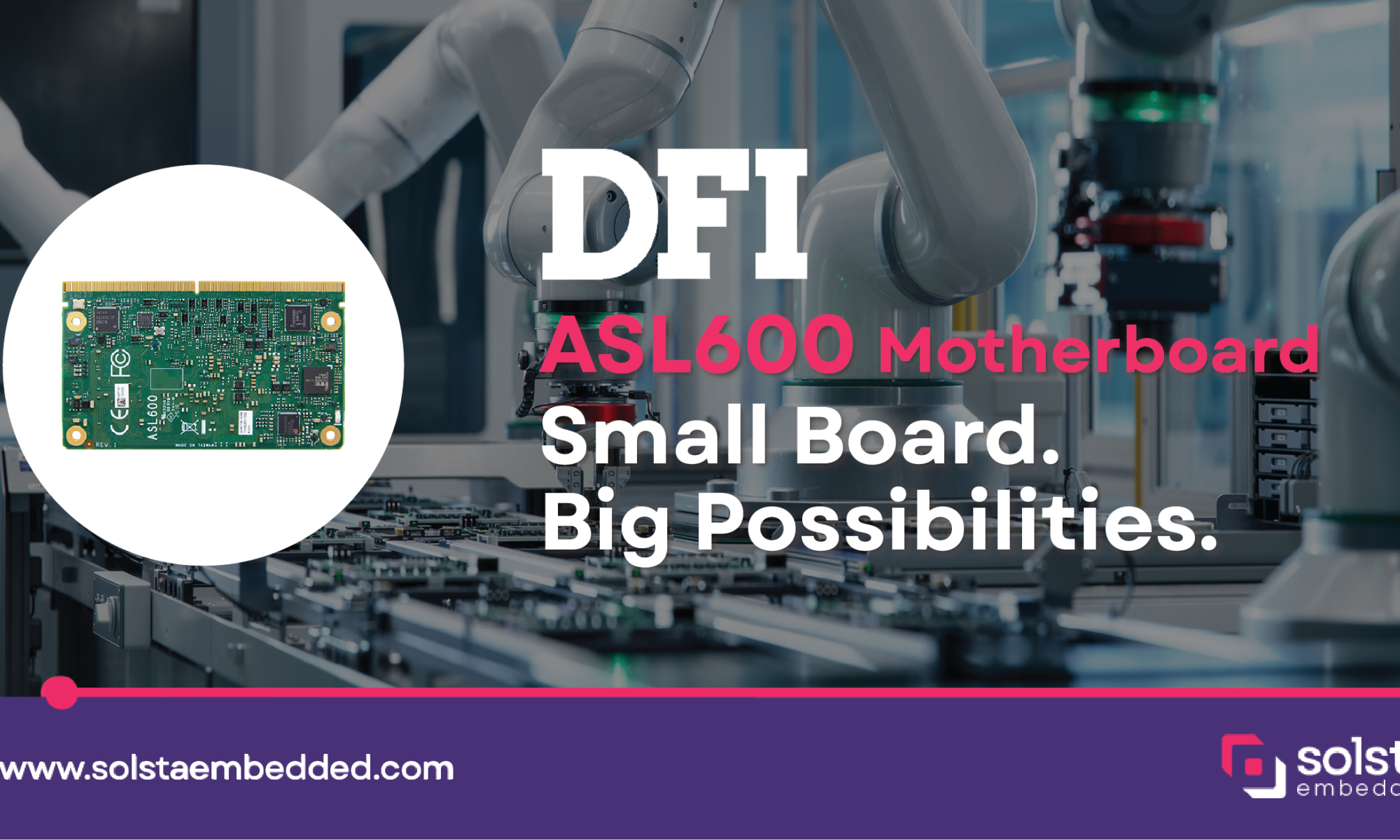
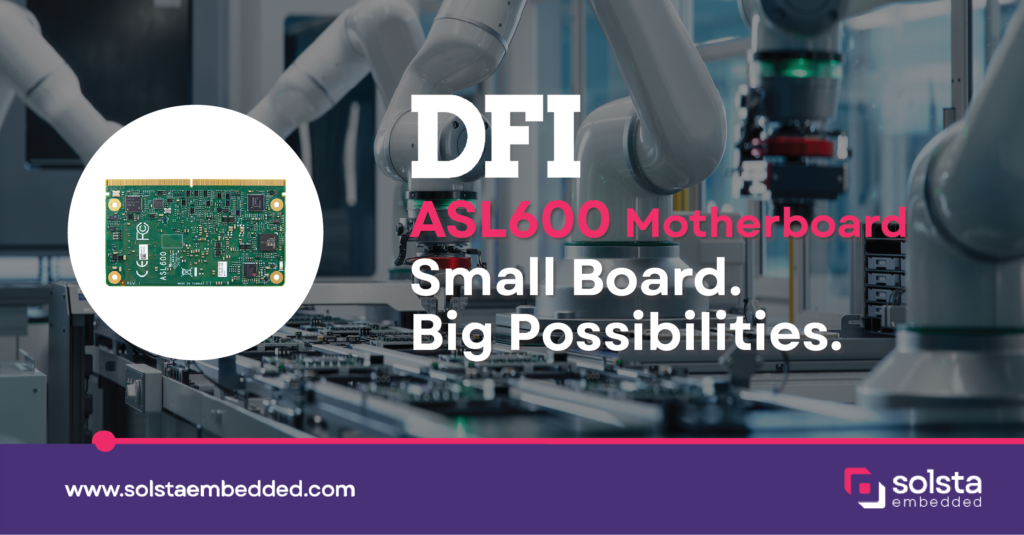
Newly added to DFI’s excellent SMARC module line up is the ASL600 module based on Intel® Atom x7000RE series processors (Code Name: Amston Lake).
Features include:
Onboard LPDDR5 4800MHz up to 16GB Supports 4K/2K resolution Triple Displays: 1 LVDS/eDP, 1 HDMI, 1 DDI Multiple Expansion: Up to 4 PCIe x1 (Gen3) Rich I/O: 2 2.5GbE, 2 USB 3.2, 4 USB 2.0, 1 SATA 3.0
SMARC (“Smart Mobility ARChitecture”) is mainly designed for applications that require extreme energy-saving and high performance in a constrained space. A full-size module measures 82 x 80 mm and short size module measures 82 x 50 mm. SMARC modules are the ideal solution for digital signage, human-machine interface, automation and portable devices.
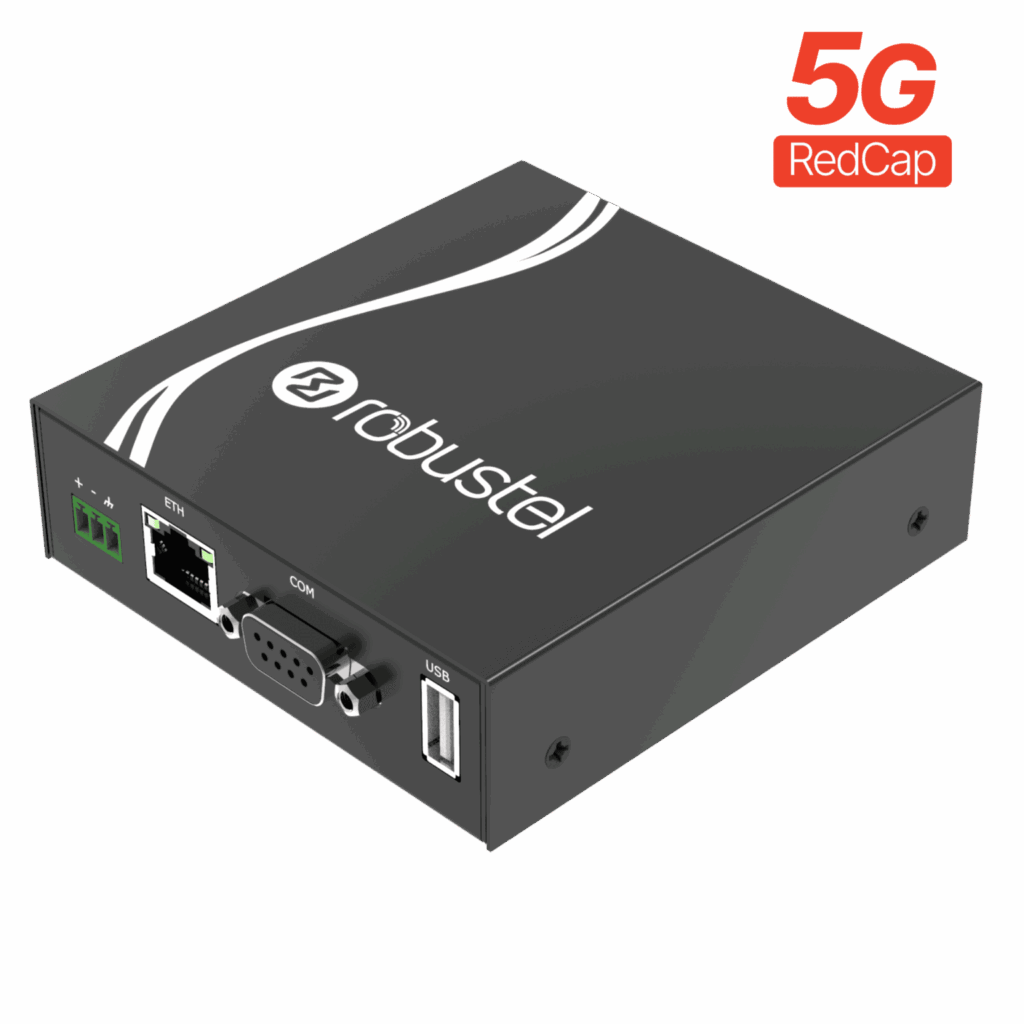
The Robustel R3000-Lite 5G RedCap brings 5G RedCap connectivity to one of Robustel’s most trusted industrial router platforms — purpose-engineered for the demanding environments of metering, pipeline monitoring, energy distribution and industrial control where reliable, secure cellular backhaul is non-negotiable.
Industrial Dual-SIM 5G RedCap IIoT Router with DB9 Serial RS-232 & RS-485
Built on the same hardened metal housing and RobustOS software stack that operators across more than 100 countries rely on, the R3000-Lite 5G RedCap integrates 5G NR-Light (3GPP Release 17) as its primary cellular technology, with 4G LTE fallback and dual-SIM redundancy to maintain connectivity through carrier disruptions without any manual intervention.
What sets the R3000-Lite apart from comparable industrial routers is its native DB9 serial interface, delivering simultaneous RS-232 and RS-485 connectivity from a single port without adapters or custom cabling. This makes it the natural choice for integrators modernising legacy assets: RTUs, PLCs, meters and SCADA field devices with existing serial interfaces can be bridged directly to 5G IP backhaul using Modbus RTU to TCP providing the resilience and operational control that critical infrastructure deployments require.
With a 9–36 V DC wide-voltage input, operating range of -40 to +75°C, and high EMS immunity to Level 3 surge, EFT and conducted susceptibility, the R3000-Lite 5G RedCap is built for enclosures and environments where standard networking hardware cannot be relied upon.
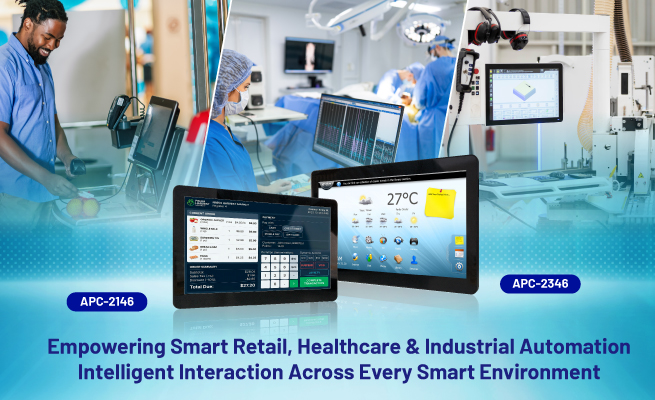
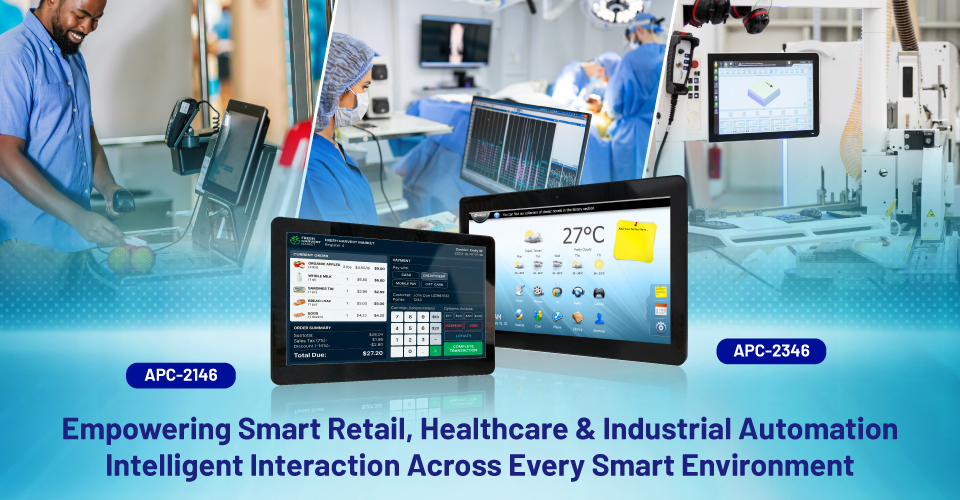
Avalue Technology Inc., a provider specialising in industrial computer solutions, has announced the launch of its new industrial panel PCs, the APC-2146 and APC-2346.
Featuring 21.5-inch and 23.8-inch Full HD displays, the new systems are powered by the Intel® Core™ Ultra 5 125U processor platform and integrate AI computing capability, fanless thermal architecture, and a slim industrial-grade design. The new APC series is designed to address diverse edge computing applications including smart retail, self-service kiosks, smart healthcare and industrial automation.
As AIoT and smart environments continue to evolve, demand for real-time data analytics, human-machine interaction and AI edge inference is rapidly increasing. Combining Intel’s latest Meteor Lake Core™ Ultra platform with a highly integrated architecture and flexible expansion capabilities, the APC-2146 and APC-2346 help system integrators and enterprise customers accelerate intelligent deployments while delivering an ideal balance of performance, reliability and space efficiency for modern edge computing environments.
Powered by Intel® Core™ Ultra Platform for Enhanced AI Edge Computing
The APC-2146 and APC-2346 are equipped with the Intel® Core™ Ultra 5 125U processor, leveraging the latest Meteor Lake architecture and integrated NPU AI engine to significantly enhance CPU and graphics performance. The systems are optimised for real-time data processing, intelligent image recognition, interactive digital applications and AI edge inference workloads.
Both models support up to 32GB DDR5 5600MHz memory and provide an M.2 Key E expansion interface for optional Wi-Fi and Bluetooth modules, enabling high-speed wireless connectivity and IoT integration. The systems also support Windows 10, Windows 11 and Linux operating systems.
Slim and Stylish Design with Industrial-Grade Durability
The APC series adopts a true-flat narrow bezel design with projected capacitive multi-touch technology (PCAP Touch), delivering an intuitive and responsive user experience while maintaining a modern aesthetic.
The APC-2146 features an ultra-slim profile of approximately 45.5 mm, while the APC-2346 measures approximately 49.5 mm in thickness. Both systems utilise a lightweight plastic chassis and fully enclosed fanless cooling design to reduce operational noise and minimise dust accumulation, making them ideal for high-dust, high-usage or mission-critical environments requiring long-term stable operation. The front panel is IP65-rated for water and dust resistance, further enhancing system reliability and ease of maintenance.
Both models offer comprehensive industrial I/O connectivity, including 2 x Intel® Gigabit Ethernet, 4 x USB 3.0, USB Type-C, HDMI, Audio Line-out / MIC-in, and 12~24V DC wide-range power input. The systems support VESA mounting and stand accessories, enabling flexible deployment on walls, counters, machinery, and mobile medical carts.
Smart Retail, Industrial Automation, and Healthcare Markets
For smart retail and self-service applications, the APC series combines high-sensitivity multi-touch capability with high-speed wireless networking to deliver smoother interactive experiences while supporting backend data synchronization and cloud integration.
In Industry 4.0 and smart manufacturing environments, the APC series serves as an HMI interface and equipment monitoring platform, supporting real-time production monitoring, quality management and equipment integration. Its fanless architecture, IP65 protection and wide-range power input make it suitable for continuous operation in demanding industrial environments, helping improve production efficiency and equipment reliability.
For smart healthcare applications, the APC series offers low-noise operation, easy maintenance and high reliability, making it ideal for bedside information systems, nursing stations, mobile medical carts and medical equipment interfaces to improve workflow efficiency and patient care quality.
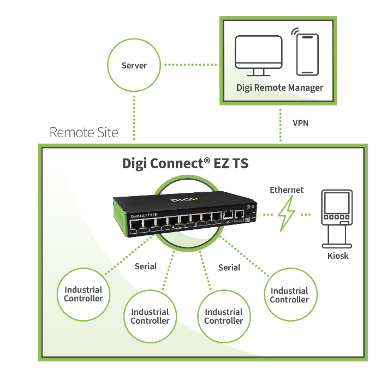
Most companies are not replacing their equipment — they are updating the way they talk to it. Digi Connect EZ TS modernises operational infrastructure with expanded network connectivity and functionality for today’s applications. Digi Connect EZ TS is designed to meet the demands of a wide range of critical serial applications including connecting to automation, robotics control, centralised device management, data acquisition and point-of-sale equipment.
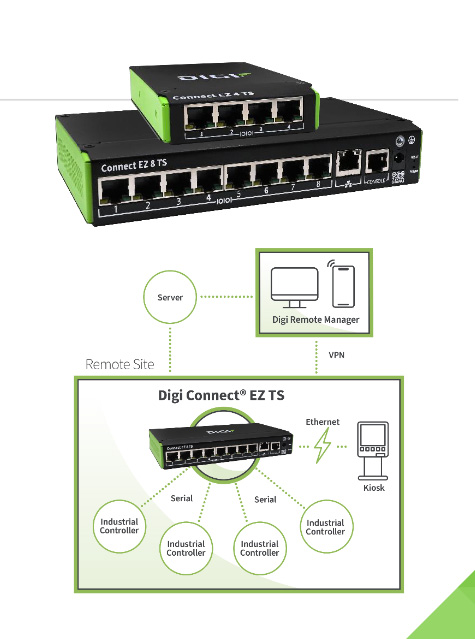
Digi has just added the new Digi Connect EZ04-TS and Connect EZ08-TS serial device servers as part of the Connect EZ product line. Digi Connect EZ TS is an efficient transition upgrade as using the same footprint does not require wiring changes. Set up is fast, with configuration in minutes. Security is a prime consideration – Digi Trustfence provides secure enterprise grade encryption. Digi Connect EZ TS has flexible management options, either cloud or on premises, and 1 year of Lifecycle Assurance is included providing 24/7 support and device management.
Digi Connect EZ TS is available in 4-port and 8-port configurations with software-selectable RS-232/422/485 communication. Designed as efficient transition upgrades for legacy ConnectPort TS and PortServer TS devices, Connect EZ TS devices preserve the same mechanical footprint and familiar workflows while delivering the power of Digi’s modern Connect EZ platform. Connect EZ TS devices take only a few minutes to configure with intelligent, use case-based options that you can quickly install without having to modify your equipment or applications.
Digi simplifies key security requirements for critical infrastructure and distributed systems with enhanced access control, management and configuration capabilities. Digi Connect EZ TS with built-in Digi TrustFence gives your security and operations teams peace of mind against evolving security threats with secure boot and encrypted connections, centralized authentication, VPN support and scalable security updates.
Digi Connect EZ TS supports the widest range of industry standard and device-specific protocols using serial tunneling, TCP/UDP connections or Digi’s patented RealPort COM port redirector for remote native COM port access. A built-in Python environment enables application development and customization at the device level, including event-based programmability, data conversion and full control of device connections.
Contact Solsta for technical support and to find out more about Digi Connect EZ TS.
The flexible and reliable TFT LCD display range from Raystar continues to benefit from product innovation with two exciting new products.
2.4-inch 240×320 Transflective TFT LCD Module
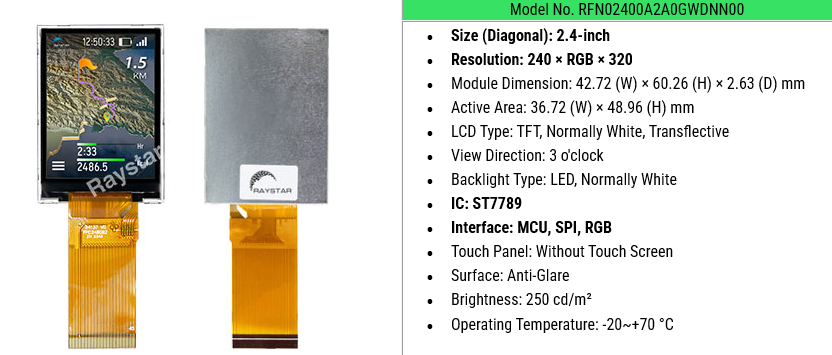
The RFN02400A2A0GWDNN00 is a 2.4-inch 240×320 TN Transflective TFT LCD Module designed to deliver excellent visibility in both indoor and outdoor lighting conditions. Featuring the ST7789 IC, it supports MCU, SPI, and RGB interfaces for flexible system integration. Its transflective design offers strong readability while maintaining low power consumption.
Built for long-term reliability, the RFN02400A2A0GWDNN00 operates within a wide temperature range of -20°C to +70°C and offers a 50,000-hour LED backlight lifetime. With a typical supply voltage of 3.3V, this display ensures stable and consistent performance for industrial controls, handheld GPS devices, and outdoor measuring instruments.
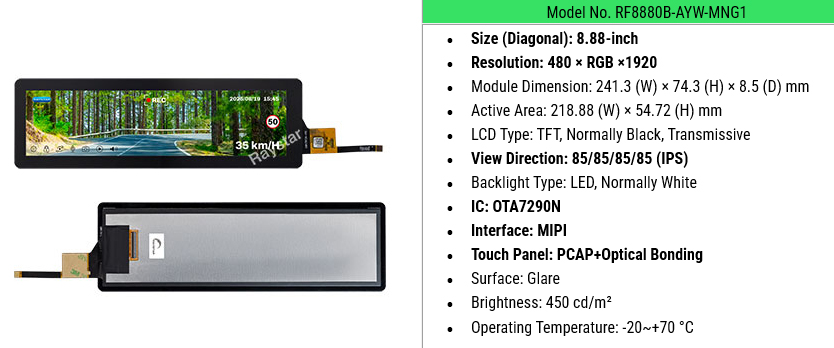
8.88-inch 480×1920 MIPI IPS Bar Type TFT Module with PCAP+Optical Bonding
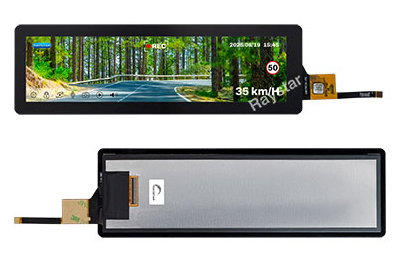
The RF8880B-AYW-MNG1 is an 8.8-inch 480×1920 MIPI IPS bar type TFT LCD module equipped with a Projected Capacitive Touch Panel (PCAP) using optical bonding. The MIPI interface ensures high-speed, low-power transmission, and simplifying system integration for a variety of embedded and industrial applications.
Designed for performance, the RF8880B-AYW-MNG1 features an PCAP+Optical Bonding that enhances sunlight readability, improves visual contrast, and provides reliable touch accuracy. Operating with low power consumption (3.3V, 35 mA typ.), it’s an excellent choice for audio-visual systems, industrial controls, smart home devices, and medical instruments.
Strip away the buzzwords and ‘AI hardware’ simply means making trade-offs around processing resources, data movement and storage, and energy. You might be working with a microcontroller (MCU) sporting a digital signal processor (DSP) or Convolutional Neural Network (CNN) accelerator blocks consuming milliwatts, an application SoC with a dedicated NPU, a graphics processing unit (GPU) module, or purpose-built inference accelerators. What matters is whether you can feed the most efficient compute engine for your application with enough data within your power budget.
Understanding these trade-offs in concrete terms – multiply-accumulate operations per second, memory bandwidth, thermal dissipation, interface latency – is what separates specification sheets from shippable products. In this article published by Electronic Specifier, Solsta’s Derek Stewart assesses these trade-offs and explores the right questions to ask to ensure project success.
Designing real-world AI hardware at the Edge
by Derek Stewart, Business Development Engineer, Solsta
Everyone is selling AI now – from Cloud platforms to AI PCs and Neural Processing Units (NPUs) on every System on Chip (SoC), whether you want it or not – but embedded engineers don’t ship hype, they ship efficient, targeted working systems. The reality on the factory floor, in vehicles or in remote devices is that AI lives or dies on how well the design utilises multiply-accumulate operations (the building block of any AI accelerator solution), memory and milliwatts, not marketing slides.
The numbers tell a quieter, more pragmatic story than the vendor presentations suggest. According to IDC, global Edge computing spend is forecast to reach around $378 billion by 2028, whilst IoT Analytics reports that the installed base of connected IoT devices is expected to climb to 21.1 billion in 2025.
This isn’t a science experiment anymore. Edge AI and embedded intelligence are large, fast-growing markets. The question for engineers isn’t if AI belongs at the Edge, but where and how much.
From AI hype to embedded reality
Strip away the buzzwords and ‘AI hardware’ simply means making trade-offs around processing resources, data movement and storage, and energy. You might be working with a microcontroller (MCU) sporting a digital signal processor (DSP) or Convolutional Neural Network (CNN) accelerator blocks consuming milliwatts, an application SoC with a dedicated NPU, a graphics processing unit (GPU) module, or purpose-built inference accelerators. What matters isn’t the marketing label, it’s whether you can feed the most efficient compute engine for your application with enough data within your power budget.
The benefits of implementing AI on the Edge over sending data to a remote server farm to be processed are clear. Edge AI algorithms execute locally so greatly reduce latency, helping to minimise external data bandwidth requirements and connection costs, as well as meet the growing number of privacy constraints, with resource-constrained hardware as the core assumption. That’s the engineering reality: you’re optimising for constraints, not chasing peak performance.
Performance metrics like Tera-Operations Per Second (TOPS) dominate datasheets, but embedded engineers care far more about TOPS per watt. Even at the lower end, devices like the Silicon Labs PG28 ARM Cortex-M33 MCU, costing just a couple of dollars, now integrate an NPU capable of running AI models eight times faster and at 1/6th of the power of the ARM core itself, demonstrating that embedded intelligence can live in milliwatt-class silicon.
Defining embedded intelligence in hardware terms
For embedded engineers, AI hardware is just another set of trade-offs and bottlenecks to juggle. TOPS on a slide means nothing if you can’t feed the accelerator with enough data or keep it within your power envelope.
The distinction between different hardware approaches matters in practical terms and it helps to think about the dimensionality of your data in your application. One-dimensional AI, which only needs to process a single serial stream of complex data such as audio keyword spotting, vibration analysis for predictive maintenance, or time-series anomaly detection, is less complex and is well suited to microcontrollers with integrated NPU/CNN accelerators operating in the milliwatt range. These are low-cost, always-on, ultra-low-power applications where the signal being processed is a potentially complex waveform changing over time. These applications are more machine learning where the model efficiently identifies the unique patterns in the data, defining its desired outputs.
Video applications introduce a second dimension to the data, greatly increasing the AI processing requirements in applications such as multi-camera vision systems, real-time object detection and visual inspection. These applications require SoCs and SoMs (System on Modules) with dedicated NPUs sitting in the watts range, or even GPU-based edge boxes consuming tens of watts for heavier workloads like AI model creation or dynamic model switching. The compute density and memory bandwidth requirements jump significantly when you’re processing image frames rather than sensor streams.
Understanding these trade-offs in concrete terms – multiply-accumulate operations per second, memory bandwidth, thermal dissipation, interface latency – is what separates specification sheets from shippable products. The hardware exists across a spectrum, and the engineering challenge is matching it to the workload and constraints you actually face.
However, there’s a human dimension too. Not every engineer is keen to hand over decades of domain knowledge to a black-box model. One motor-monitoring specialist put it bluntly: after years building hand-crafted mathematical models of bearing wear and vibration signatures, why would he ‘throw AI at it’ and lose visibility into what the system is actually detecting? That reluctance isn’t Luddism – it’s a legitimate concern about explainability, trust and maintainability. The best embedded AI projects don’t replace engineering judgement; they augment it with tools engineers can understand, validate and trust.
Where AI on the Edge fits (and where it doesn’t)
The art isn’t running everything at the Edge or pushing everything to the Cloud. It’s carving up the problem, so each layer does what it’s best at.
Use the Edge when you must: for latency, bandwidth, privacy, or resilience. Autonomous vehicles, industrial control, and smart healthcare often require millisecond response times and enhanced data security and can’t tolerate Cloud latency or connectivity loss. Sensor suites in autonomous vehicles (cameras, radar, lidar) generate tens of terabytes daily, making Cloud streaming impractical. Processing data close to sensors reduces network traffic and energy whilst keeping sensitive data local for regulatory compliance.
Use the Cloud when you can: for heavy training, fleet-wide retraining, and data aggregation. Hybrid architectures often make the most sense, with lightweight inference at the Edge and periodic model updates handled centrally.
Accuracy, safety and ‘good enough’ intelligence
In embedded and safety-critical systems, ‘good enough’ AI is a very precise phrase. You must know what accuracy, false positives, and false negatives mean in real operational terms – and keep deterministic safety nets in place.
Again, this comes down to the trade-offs you must consider between a larger more accurate model, which can take longer to run and consume more power, and a lighter weight model that may not be as accurate.
Real-world deployment accuracy routinely falls several percentage points below laboratory benchmarks due to noise, occlusion, and domain shift. Quantisation techniques, running models at 8-bit or sub-8-bit precision, can significantly reduce the size and execution time (inference latency) of your model and hence energy consumption whilst keeping accuracy within a few points of full-precision baselines, but only after careful validation.
In safety-critical domains, AI should be integrated as decision support and should not be the only safety mechanism, with continued focus on traceability, explainability and adherence to standards like ISO 26262 or IEC 61508.
Practical hardware and tooling considerations
Don’t pick hardware in a vacuum. Modern Edge AI deployments increasingly rely on heterogeneous compute – that is combinations of central processing unit (CPU), GPU, DSP, and NPU working together, with the scheduler assigning workloads based on efficiency and latency requirements. A dedicated NPU might handle continuous inference tasks to benefit from its efficient parallel processing capabilities, whilst the CPU manages the more general-purpose control logic and the GPU processes occasional heavier vision workloads.
The architectural choice between integrated and add-on accelerators matters too. As mentioned, vendors like Silicon Labs offer microcontrollers and ISM band RF SoCs with built-in AI acceleration suitable for one-dimensional workloads, whilst companies like DeepX provide companion chips and modules that bolt onto existing processors (discretely or via an M.2 plug in card) when you need more inference capability without redesigning your entire platform. Their proprietary ‘Intelligent Quantisation’ (IQ8) techniques help to deliver the performance levels required of modern Edge AI deployments. Each approach has trade-offs: integrated solutions offer tighter power management and lower latency, whilst add-on accelerators provide upgrade paths and flexibility for evolving models.
Intel’s reference blueprint for Core Ultra processors demonstrates heterogeneous compute in practice: NPU and integrated GPU configurations balance multi-stream computer vision and small generative models with significantly better performance per watt than GPU-only setups. However, raw silicon capability is only half the story.
The skills gap is real: traditional embedded teams often lack experience in data management, model generation and optimisation techniques like quantisation and pruning, and efficient inference deployment on constrained devices. A slightly smaller NPU with a great toolchain and strong community support often beats a monster chip with a poor software ecosystem.
Start with questions, not chips
The winning teams aren’t the ones with the biggest NPU; they’re the ones who frame the right problem, own their data, develop or select realistic models and choose hardware and tools that match those constraints efficiently.
Start by asking the right questions: What problem are you solving? What latency can you tolerate? What data do you have – quality and quantity? What’s your power budget? What safety requirements apply? Only then look at hardware options.
De-risk projects by bringing hardware, software, and firmware engineers together early, use pre-trained models as a starting point where they exist and simulate performance on different hardware options before committing to silicon. You don’t need to become a data scientist overnight. A disciplined engineering mindset, understanding constraints, trade-offs and verification, is exactly what’s needed to make embedded intelligence work.
If you start with the right questions about latency, bandwidth, power, safety, and data, the AI hardware choices become clearer. Embedded intelligence isn’t about chasing the biggest model; it’s about building systems you can trust, maintain, and ship.
Derek Stewart, Business Development Engineer, Solsta
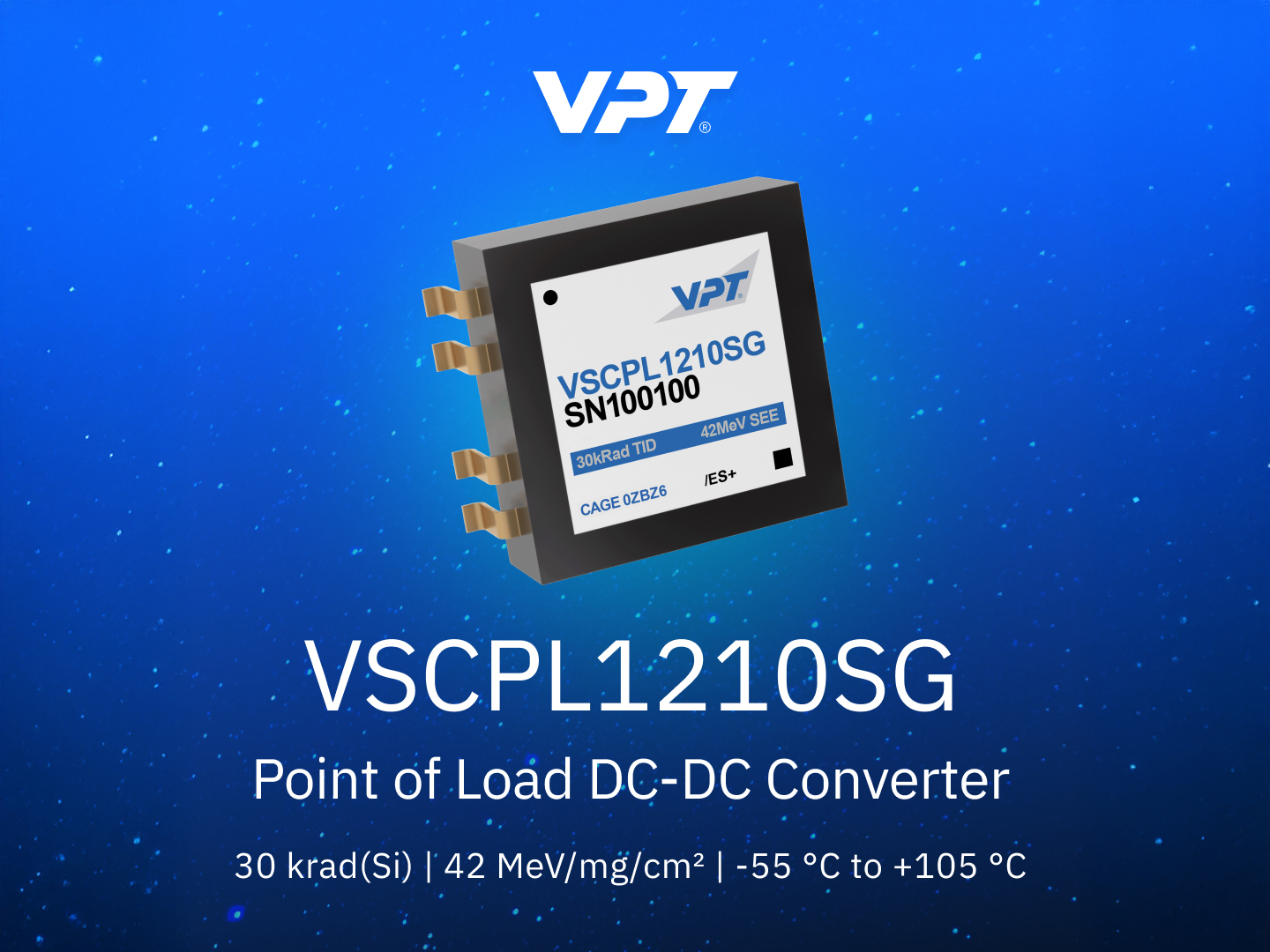
VPT, Inc. has announced the VSCPL1210SG, the first point of load DC–DC converter in its award–winning VSC Series of space–grade COTS power supplies. Delivering up to 10 A of output current with peak efficiency up to 95%, the VSCPL1210SG expands VPT’s NewSpace product offering and completes a full power–conversion solution that includes isolated DC–DC converters, point of load converters and EMI filters.
The VSC Series is a commercial off–the–shelf (COTS) product line designed for smaller satellites in low Earth orbits (LEO), and NASA Class D missions where the balance of cost and guaranteed performance is critical. This series is radiation tested to 42 MeV/mg/cm² with no destructive SEE events (SEGR, SEB, SEL) and tested to 40 krad(Si), guaranteed to 30 krad(Si), for TID in accordance with VPT’s in–house radiation hardness assurance (RHA) plan.
Operating from a 4.5 to 13.2 V input, and offering an adjustable output from 0.8 to 5.0 V, the VSCPL1210SG delivers reliable performance across the full temperature range of –55 °C to +105 °C with no power derating. Its proprietary packaging enables dual–side heatsinking with low outgassing, while the surface–mount design supports streamlined reflow soldering and simplified board–level integration.
“We designed the VSCPL1210SG to deliver high efficiency, tight regulation, and simplified board-level integration while maintaining the radiation tolerance required for LEO environments,” said Brandon Witcher, Principal Design Engineer. “The goal was to meet NewSpace performance needs without pushing beyond the cost constraints that define this market.”
VPT will introduce two additional point of load converters later this year to further expand the series, : the VSCPL0510SG with a 10 A output and the VSCPL1220SG with a 20 A output.
The VSC Series complements VPT’s hermetic hybrid SVL Series of rad hard products available on DLA SMDs.
The VSCPL1210SG is manufactured in an ISO9001, J-STD-001, and IPC-A-610 certified facility and is available for order now. Sales are subject to all applicable U.S. export license restrictions and regulations.
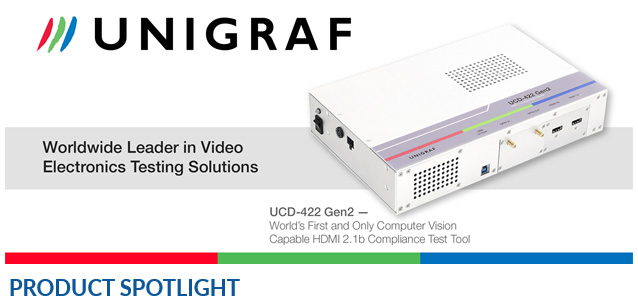
Unigraf, a leader in audio and video testing solutions, has launched the UCD-422 Gen 2, the industry’s first HDMI test solution to feature a computer vision approach for validation and compliance.
Powered by Unigraf Vision Intelligence™ — a breakthrough technology that transforms HDMI compliance testing from a time-consuming, manual task into a rapid, deterministic, and fully automated workflow that dramatically reduces validation time while improving testing accuracy.
Key Highlights
New Technology
The UCD-422 Gen 2 is the first HDMI test solution to employ computer vision, a specialized field of AI that allows computers to interpret and analyze data from videos and other electronic images.
Accelerated Testing
The computer vision approach transforms a 13-hour manual validation process into an automated, one-hour workflow. This is expected to shorten critical areas of HDMI compliance testing cycles by up to 90%.
Improved Accuracy
The new system dramatically improves test accuracy by eliminating tedious, human-based manual checks, which removes error-prone human variability.
Comprehensive Support
The UCD-422 Gen 2 is a versatile platform supporting HDMI 2.1b and is approved by the HDMI Forum for industry-required HDMI and HDCP compliance tests across all critical categories (sink, source, and repeater devices).
o Quick Media Switching and Variable Rate Refresh (QMS/VRR) o ALLM (Auto Low Latency Mode) o FEC (Forward Error Correction) o DSC, eARC, CEC 1.4b & 2.x o HDCP 1.4/2.3 o Extreme Resolutions: The system supports resolutions up to 10K@30Hz and 8K@60Hz without Display Stream Compression (DSC).